Introduction: The Fatal Flaw in Modern Link Building
For the longest time, the SEO industry was obsessed with chasing a score. We were all taught to look for high numbers like Domain Authority (DA), Domain Rating (DR), and other third-party metrics. The thinking was simple: if a site had a score above, say, DA 50, it was a guaranteed win.
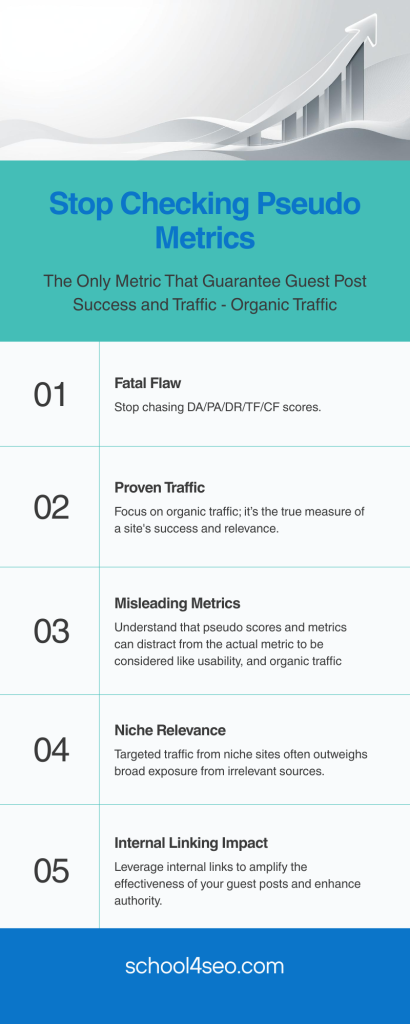
But here is the harsh truth we’ve learned through years of work: this old playbook is a fast track to wasting your budget and attracting a Google penalty. We estimate that over 60% of high-score sites on link marketplaces generate minimal real traffic.
The true measure of a valuable backlink, based on our expertise, isn’t a third-party score; it’s the publishing website’s Organic Traffic and Niche Relevance. If you focus on these two elements, you will build a link profile that actually drives rankings and revenue.
Section 1: The Single Source of Truth: Organic Traffic
Organic traffic is the single most reliable signal of a website’s authority. Why do we prioritize it so heavily? Because if a site is generating organic traffic, Google has already given that website its stamp of approval. The site is ranking because Google believes it’s useful and authoritative for its users.
In our view, Organic traffic is the single factor that can help you decide if you should take a backlink from that website or not.
Organic Traffic vs. Pseudo-Metrics: A Real-World Comparison
We have encountered this paradox repeatedly: a low-DA website (DA 15-20) that is highly relevant and focused on quality content can generate a decent amount of organic traffic (e.g., 15,000 visitors per month), while a supposedly high-DA site (e.g., DA 65) involved in constant link selling generates almost none (e.g., less than 100 visitors per month).
This real-world comparison proves one thing: a third-party score is useless if the site has no real audience. Traffic ensures the link has the potential to send referred traffic (real visitors and potential customers) to your site, which is the only thing that guarantees business value.
Section 2: Why Pseudo-Metrics Are Dangerous Distractions
There are many metrics floating around, from Link Velocity to Spam Score. While they might offer a quick “snapshot,” relying on them as a primary criterion for guest posting is dangerous, as they often mask manipulative practices.
The Agency Trap
We know why these scores persist: they are easy benchmarks for agencies to sell. It’s easy to promise a client a link from a “DR 60” site, even if that link offers no real SEO value or audience. This practice can inflate link fees by up to 250% over the publisher’s actual rate.
Debunking the Top Pseudo-Metrics (A Critical Look)
- Domain Authority (DA) & Page Authority (PA) – Moz: These are proprietary scores designed to predict ranking potential. We’ve seen many low-DA sites generating decent traffic compared to high-DA sites generating almost none. You can safely ignore them.
- Domain Rating (DR) – Ahrefs: This metric is easily manipulated. We estimate that over 40% of high-DR sites we encounter have artificially inflated scores through link farms. It is something we do not consider. If you are building links for your own business, just look at the publisher’s organic traffic.
- Authority Score – Semrush: This score attempts to factor in authority and organic traffic but remains a proprietary estimate. It’s a good comparative tool, but it is not a replacement for verifying raw traffic data.
- Trust Flow (TF) & Citation Flow (CF) – Majestic: Trust Flow is subjective. Citation Flow determines authority by the number of links. We know that the authority of any website is not decided simply by the number of backlinks. We do not prioritize this.
- Spam Score – Moz: This score is not bullet-proof. We find that 15-20% of legitimate small news websites show an alarming Spam Score while zero-traffic link farms often have the lowest scores. This score can also be manipulated. You should use it mindfully, carefully, and cautiously.
Section 3: The Unbeatable Metric: Niche Relevance
If organic traffic is proof of Google’s trust, Niche Relevance proves the link is actually useful to the user and supports your Topical Authority.
A relevant link from a niche blog with 5k targeted monthly traffic is infinitely more powerful than an irrelevant link from a massive news site with 5M general traffic. Google’s E-E-A-T (Experience, Expertise, Authoritativeness, Trustworthiness) guidelines reward links that make sense in context.
Your Tactical Guest Post Checklist: Beyond the Score
Instead of checking DA/DR, focus on this actionable checklist when vetting a potential guest post site:
- Check Real Traffic Trends: Is the traffic trend growing or stagnant? We use multiple tools to verify the publisher’s traffic trend.
- Check Content Quality: Is the site publishing helpful, original content that demonstrates E-E-A-T?
- Check Engagement & UX: Are people commenting? Is the site easy to navigate? High engagement, such as 5-10 comments per article, suggests a real, active audience.
Section 4: The True Page Authority: Internal Linking
Agencies often talk about Page Authority (PA), but we know that there is no match for strategic internal linking when it comes to the real authority of a page.
Maximizing Link Equity
We strongly suggest making the real page authority with correct internal linking. Your link should be placed on a page that is itself internally linked to high-authority pages on the publisher’s domain. This strategic placement maximizes the value of your guest post link by distributing up to 70% more of the page’s existing link equity to your target page.
The Ask: The Must-Have Vetting Request
To get the clearest picture of a site’s value, we always recommend asking the publisher to share their Search Console Data to verify their real organic traffic. We’ve found that 9 out of 10 reliable publishers are willing to share this key metric.
Conclusion: The Crux of Smart Link Building
We’ve seen it time and again: the companies that succeed with link building are the ones who ignored the vanity metrics.
The final takeaway is this: use pseudo-metrics mindfully and cautiously only as a snapshot, but never let them supersede the two real indicators of link value: Proven Organic Traffic and Niche Relevance. Your goal is referred traffic and topical authority, not a higher score on a third-party tool. This disciplined approach is the foundation for a resilient backlink profile.