Last Updated on 2 months ago by School4Seo Team
Introduction: The Evolution of Search Quality
The landscape of search engine optimization has matured significantly. Modern SEO success is no longer defined by keyword density or technical tricks, but by the tangible value and credibility a website offers its users. At the core of Google’s quality assessment framework lies E-E-A-T (Experience, Expertise, Authoritativeness, and Trustworthiness).
While technical SEO and content strategy are essential, a frequently overlooked driver of E-E-A-T is branding. A strong, consistent brand acts as the primary visual signal of professionalism and reliability. This article will dissect how foundational branding elements influence user perception, enhance site performance, and ultimately bolster the crucial E-E-A-T signals that underpin high search rankings.
I. Branding as the Foundation of Trustworthiness (T)
Trustworthiness is the bedrock of E-E-A-T, and it is instantly communicated through a website’s visual integrity. A site that looks professional, stable, and current immediately earns more user confidence than one that appears dated or haphazard.
The Critical Role of the Logo
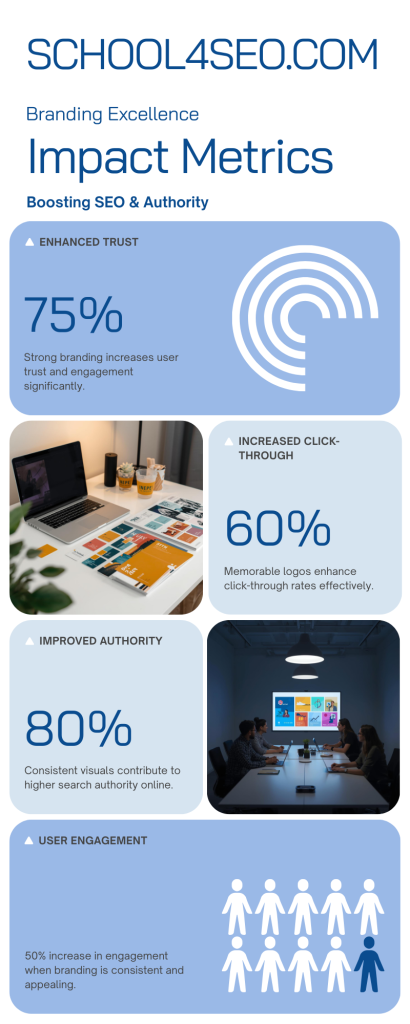
The logo, as the primary visual identifier, is a potent trust signal.
While a logo does not function as a direct SEO ranking factor, its design profoundly affects brand trust and recognition, which are powerful indirect drivers of search performance. A professional, memorable logo instantly conveys authority and legitimacy, encouraging users who find your site via a SERP to click and stay (reducing bounce rate). Furthermore, a well-designed logo, regardless of whether it’s the result of intensive design work or a tool like Adobe’s Logo Maker, is crucial for social media sharing and off-site branding. When high-quality external sites link to you, seeing a credible logo reinforces their decision to cite you as an authoritative source, ultimately aiding in your link-building efforts, a key SEO pillar. Invest in a logo that is scalable, distinctive, and aligns with your brand’s message, as it is one of the first trust signals a user evaluates.
Site Consistency and Reputation
Trust is also built through consistency. Using a standardized color palette, typography, and visual style across all digital touchpoints prevents the site from appearing disorganized. This aesthetic coherence suggests a structured, reliable operation behind the content. Furthermore, visible contact information, clear privacy policies, and transparent author attribution enhance the site’s perceived legitimacy, directly feeding into the ‘Trust’ score assessed by Google’s Quality Raters.
Expert Quote:
“In the age of generative AI, authenticity and visual credibility are the new moat for SEO. Your branding is the tangible evidence of your commitment to quality. If your site looks untrustworthy, Google’s algorithms, driven by user behavior, will eventually reflect that skepticism in the rankings,” states Aleyda Solis, International SEO Consultant.
II. Visual Integrity and Experience (E)
Google’s emphasis on user experience is now codified in its Core Web Vitals. Branding elements directly intersect with this technical performance.
Core Web Vitals and User Perception
A slow-loading or visually jarring site immediately degrades the user experience. Branding elements must be optimized to ensure speed:
- Optimized Imagery: Branded images (e.g., custom graphics, charts) build visual authority, but they must be properly compressed and sized to prevent high bounce rates and poor scores on Largest Contentful Paint (LCP).
- Mobile Responsiveness: A premium brand experience requires that the logo, navigation, and visual style scale flawlessly across all devices. Any breakdown in the mobile display is a critical failure in both UX and technical SEO.
Scenario: The Trustworthiness Test
Consider two websites publishing an identical article on Google Ads targeting. Website A is well-branded, uses optimized, unique graphics with its logo watermark, and loads in 1.5 seconds. Website B uses generic stock photos, has an inconsistent color scheme, and takes 4 seconds to load. Users who land on Website B are significantly more likely to bounce back to the search results page. This poor dwell time and high bounce rate signal to Google that Website B is a lower-quality result, irrespective of the article’s text quality. The branding and performance gap determines the ultimate search ranking.
III. Branding Reinforces Expertise and Authoritativeness (E & A)
Expertise and Authoritativeness are demonstrated not only through the depth of content but also through how that content is presented and attributed.
Establishing Authoritative Content Presentation
A strong brand ensures that content is immediately recognized as coming from an expert source.
- Branded Graphics and Visualizations: Creating unique charts, data visualizations, and infographics that include your site’s branding prevents them from being confused with generic assets. This signals to Google that your site is the original source of the data or concept, enhancing your Authoritativeness.
- Clear Author Attribution: Every piece of high-value content must feature a professional author bio, complete with a clean, high-quality photograph and links to relevant social profiles (especially LinkedIn). This practice solidifies the ‘Expertise’ behind the article, connecting the content to a real, verifiable professional.
Expert Quote:
“The branding of your research and data visualizations directly contributes to your site’s citation potential. When a publisher or journalist looks for a statistic, they are far more likely to link to a source that looks authoritative and professional. In link building, your brand is the silent validator,” notes Rand Fishkin, Founder of SparkToro.
The Magnet for Branded Search
As your brand image strengthens through consistent, professional presentation, users begin searching for you specifically. The increase in branded search queries (e.g., searching for “School4SEO Certifications” rather than “SEO Certifications”) is a direct, undeniable signal to Google of your market authority and recognition. A strong brand becomes a powerful off-page SEO magnet, encouraging links, social shares, and direct traffic.
Conclusion
Branding elements are not merely aesthetic choices; they are performance drivers that directly influence the signals Google uses to rank content. By ensuring that your logo, visual identity, content presentation, and site architecture are professional, consistent, and optimized for speed, you are actively bolstering your E-E-A-T score. In modern search, investing in your brand’s integrity is the most effective way to invest in sustainable, long-term SEO authority.