I’ve been managing high-traffic websites for years, and if there’s one thing I’ve learned, it’s this: A cookie banner is not a privacy strategy. Most webmasters treat a consent manager like a “checkbox.” They install a plugin, see the popup, and assume they are compliant. But if you look under the hood of 90% of those sites, they are still “bleeding” user data to third parties before the visitor even has a chance to click “Decline.”
I call these Shadow Trackers. They are the silent leaks in your hull that can lead to heavy fines and, more importantly, a betrayal of your users’ trust.
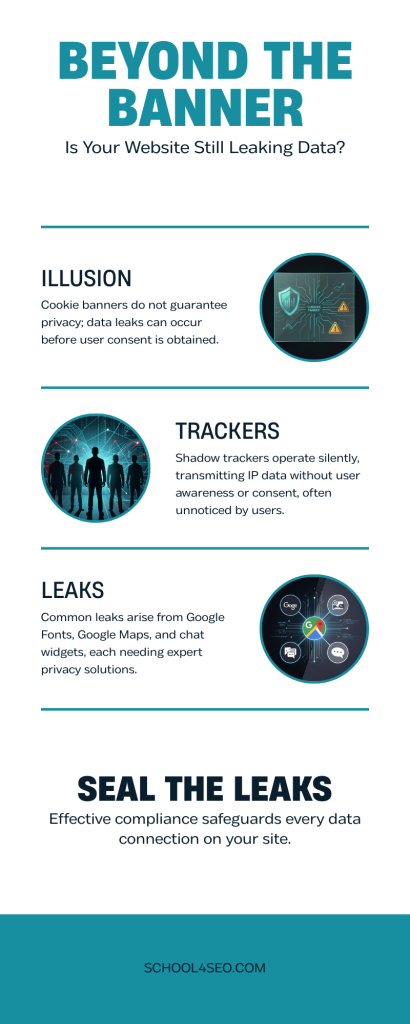
The Illusion of Compliance
The biggest misconception in 2026 is that “Cookies” are the only problem. Privacy laws like GDPR and the DMA aren’t just about small text files; they are about Personal Data Transfer. The moment a user’s browser talks to a third-party server (like Google’s or Meta’s), their IP Address—a piece of personal data—is transmitted. If this happens before consent, you have a leak.
3 Critical “Shadow Leaks” You Likely Have Right Now
1. The Google Font Trap
We all love beautiful typography. But if you are calling Google Fonts from their API (fonts.googleapis.com), you are handing over every visitor’s IP address and their exact browsing location to Google.
- The Expert Move: I host all my fonts locally. By moving the font files to my own server, the browser never has to “call home” to Google. It’s faster, and it’s 100% private.
2. The “Active” Map Embed
Embedding a Google Map is convenient, but it is a privacy nightmare. The second that map renders, Google begins fingerprinting the user.
- The Expert Move: Use a Privacy Facade. Instead of the live map, I show a high-quality static image of the map. The real, interactive Google Map only loads if the user specifically clicks “Show Map” and gives consent.
3. The “Chatty” Social Widget
Facebook Messenger and WhatsApp widgets are incredible for conversion, but they are “on” the moment the page loads. They track users who never even intended to chat with you.
- The Expert Move: I use Conditional Loading. The chat script stays “dead” until the user interacts with a custom chat bubble I’ve built. This keeps the site fast and the data safe.
Why “Step 3” is the Only Step That Matters
In my previous article, I mentioned that installing a banner is only 20% of the work. The remaining 80% is Service Mapping.
If your banner doesn’t have the “brains” to hold these scripts hostage until consent is granted, your banner is just a piece of digital theater. This is where most DIY setups fail. They have the “sign on the door,” but the “back door” is wide open.
How I Audit My Own Sites
Every month, I run a “Shield Check” on my properties. I use browser developer tools to watch the Network Tab. If I see a single request to a third-party domain before I click “Accept” on my banner, I know I have work to do.
Is Your Site Leaking?
Most high-traffic owners are too busy growing their business to monitor network requests. That’s where I come in. I don’t just “install a banner”—I seal the leaks.
I will audit your site for Shadow Trackers, move your fonts to local hosting, and wrap your maps and chats in “Privacy Facades” so you can sleep at night knowing your compliance is real, not just an illusion.